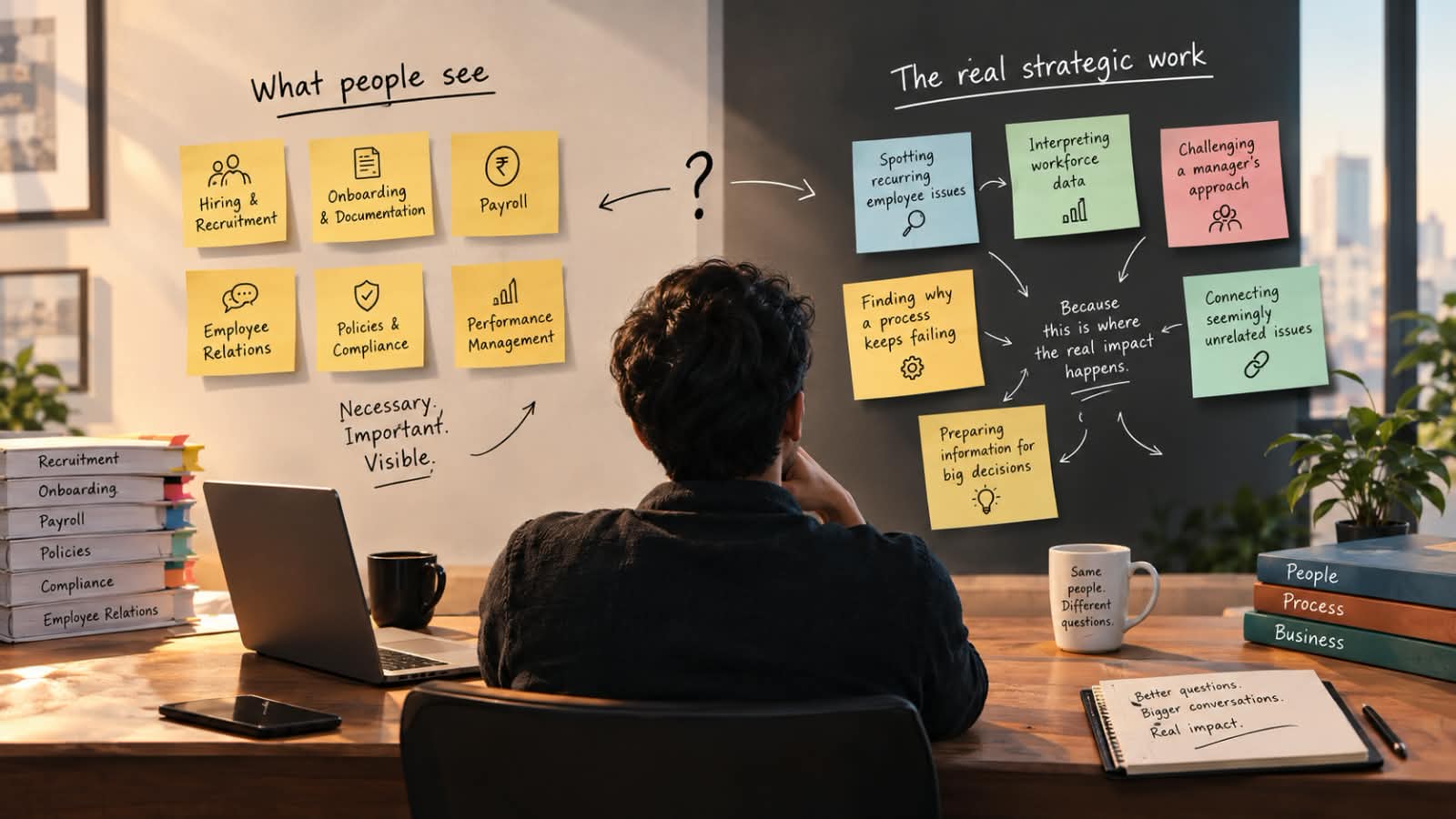
The more I think about the way we use the term "strategic HR", the more loosely it seems to be used. It has almost become a label that gets attached to certain HR roles, rather than something that clearly describes the work being done.
We call someone an HRBP, a Strategic HR Partner or a Strategic HR Manager, and somehow that is expected to mean that the person is working on the strategic side of HR. But if we actually look at what the person is doing, how much of it is truly strategic?
This is not to say that operational HR work is unimportant. Hiring, onboarding, employee relations, payroll, performance management and all the other things HR does are necessary for an organisation to function. But somewhere along the way, we seem to have started treating the movement away from these activities as the movement towards strategic HR.
And I am not sure that is the right way to look at it.
So what does strategic HR actually mean?
If an HR professional is not spending most of their time processing documents, coordinating recruitment or resolving individual employee issues, what should they actually be doing with that time?
Is it analysing workforce data and understanding what it is telling the business? Is it identifying why attrition is happening instead of simply reporting the attrition number? Is it questioning whether a manager's approach to people is creating a larger organisational problem? Is it understanding why the same employee issue keeps reaching HR despite being "resolved" multiple times?
Or perhaps it is something as simple as asking management questions that nobody else in the room is asking.
If a business wants to expand, what does that mean for its people capability? If a team is growing rapidly, can its current manager structure support that growth? If a particular function has consistently high attrition, is the problem really the employees leaving or something within the way that function operates? If productivity is falling, is hiring more people actually the answer?
These are not necessarily complicated questions. But they require HR to understand the business beyond the HR process itself.
This is where I feel strategic HR is often misunderstood.
We tend to think that strategic HR is about doing something more sophisticated than operational HR. More dashboards, more presentations, more workforce reports and perhaps a seat in more management meetings.
But being present in a management meeting does not automatically make HR strategic.
The real value comes from what HR brings into that meeting.
If HR is only presenting headcount, attrition percentages and hiring numbers, it is reporting. If HR can explain what those numbers could mean for the business, challenge the assumptions behind them and connect them to decisions that need to be made, that starts looking much more strategic.
And interestingly, much of the information required for this already sits within HR's everyday work.
The recurring employee complaint. The manager who keeps escalating similar issues. The department that constantly struggles with retention. The process that requires repeated manual intervention. The employees who keep asking the same question because a policy isn't clear. The data that looks normal until it is compared with another part of the organisation.
These things are easy to treat as individual HR activities.
But perhaps they are organisational signals.
The problem is that these signals are not always visible in the conventional definition of strategic HR. They don't necessarily appear as a large project or a presentation to the leadership team. Sometimes strategic work is simply noticing a pattern that everyone else has become used to.
And I think this is also why such work is not always identified or prioritised.
Execution has a visible output. A position gets closed. Payroll gets processed. An employee issue gets resolved. A policy gets implemented. There is something tangible at the end of it.
Strategic thinking is different. Sometimes the output is a question. Sometimes it is a recommendation. Sometimes it is convincing a manager not to take a particular approach. Sometimes it is preventing a problem that nobody will ever know could have happened.
That makes it much harder to measure.
But perhaps the answer is not to move HR further away from execution.
Perhaps HR needs to get better at looking at execution differently.
The work happening at the operational level is producing information every day. HR just needs to move beyond solving each issue individually and start asking what the collection of those issues is telling us.
That is where I think the way ahead lies.
Instead of asking whether an HR role is strategic or operational, perhaps we should ask whether the HR professional is able to connect the two. Can they take what they observe on the ground and turn it into something useful for a business decision?
Because the most strategic HR professional may not always be the person doing the biggest HR project.
It could be the person who notices that three seemingly unrelated problems are actually connected.
Maybe the problem with strategic HR is not that organisations don't have enough people in strategic HR roles.
Maybe we have not clearly defined what strategic HR work actually looks like.
If strategic HR simply means doing less administration and attending more leadership meetings, we have probably misunderstood it.
Strategic HR, to me, should mean understanding people, processes and business decisions well enough to see what is coming before it becomes an obvious HR problem.
And perhaps that is why some of the most strategic HR work is also the work nobody sees.
Because when it is done well, it does not always create a visible HR outcome.
Sometimes it simply helps the organisation make a better decision.