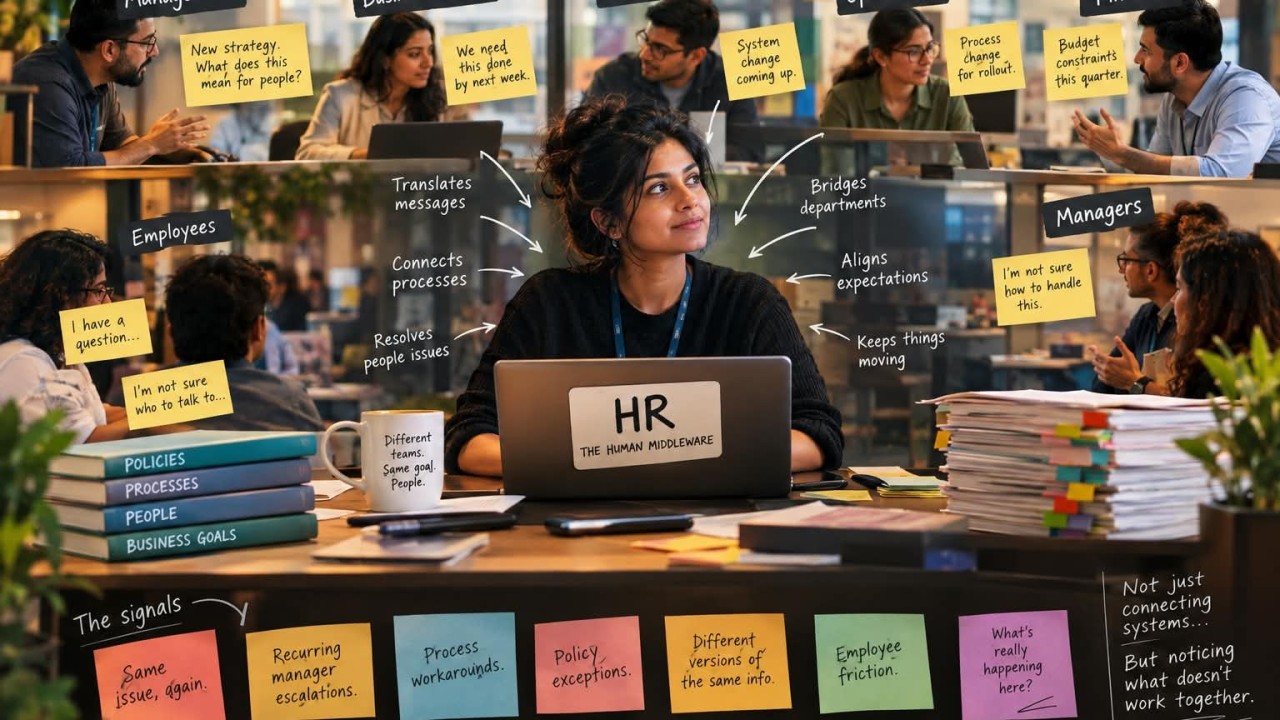
The more I think about the way HR operates inside an organisation, the more I feel that there is a part of the role that we don't really talk about enough. HR is usually described through the work that it owns - hiring, employee relations, payroll, policies, performance, engagement and everything else that comes under the people function. But a significant part of what HR actually does happens somewhere in between these defined responsibilities.
A business decision comes from management. Someone has to understand what it means for employees, communicate it, handle the questions that follow and sometimes make sure that the decision can actually be implemented. A process is changed by another function. Someone has to understand how that change affects people and where it could create problems. A manager has a difficult employee situation. HR gets involved even when the underlying problem may have started somewhere else.
This made me think about something that sounds slightly unusual at first - has HR become the company's human middleware?
In technology, middleware exists between different systems. It helps them communicate, exchange information and work together even though they were not necessarily designed in exactly the same way. HR seems to perform a similar function with the different parts of an organisation, except that the systems involved are not just software. They are people, managers, processes, policies, business requirements and organisational decisions.
But if that is actually what HR is doing, why do we so often describe this work simply as execution? I don't think it is because the work itself is necessarily less important. In fact, it can be some of the most important work happening within HR. The problem is that much of it is difficult to see once it has been done.
When a manager understands how to handle an employee issue because HR helped them navigate it, the outcome may simply look like a problem that was resolved. When an issue in a process is identified and corrected before it affects a larger group of employees, nobody really sees the problem that was prevented. When HR spends time connecting information from different teams to make sure something works for employees, the final outcome may just look like a process that worked as expected.
And perhaps this is one of the reasons why HR can sometimes find itself caught between being considered operational and trying to establish itself as strategic.
We often speak about strategic HR as though it exists separately from operational HR. There is execution on one side and strategy on the other, and the natural progression seems to be that HR should gradually move away from the former and towards the latter.
But I am not sure that the separation is always that simple. A lot of the information required to make a good people decision comes from the operational side of HR. Employee concerns, recurring payroll issues, attendance patterns, manager escalations, process failures, policy exceptions and even the questions employees repeatedly ask can tell us something about the organisation.
The problem is that HR can become so occupied with solving these things that it doesn't get enough time to ask why they are happening repeatedly.
That is where the difference between an execution-heavy HR role and a strategic HR role may actually become clearer to me. It may not be about whether HR is involved in execution. It may be about what HR does with what it learns from that execution.
If the same employee issue keeps coming to HR, closing the issue may be necessary. But understanding why it keeps coming back is where the larger value starts.
If managers repeatedly need HR's help with the same kind of situation, resolving each individual case is part of the job. But understanding whether there is a capability, communication or process problem behind those cases is a different level of contribution.
If employees keep finding ways around an existing process, it may be easy to treat those as individual exceptions. But perhaps the exceptions are telling us that the process itself does not fit the way work actually happens.
This is where I think the middleware comparison becomes relevant. HR sits in a position where it gets to see different parts of the organisation at the same time. Management sees the business requirement. Employees experience the outcome. Managers deal with the practical reality in between. Other functions own their respective processes. HR often ends up seeing how all of these things interact with each other.
That doesn't automatically make HR strategic. But it does give HR a perspective that can become strategic if it is used properly. There is also a danger in this position. If HR becomes very good at absorbing problems from other parts of the organisation, it can unintentionally make those problems less visible.
A process doesn't work properly, but HR finds a way around it. A manager struggles with an employee issue, but HR steps in and resolves it. Different teams have different information, but HR spends time reconciling it. Employees face friction in a process, but HR helps them navigate it.
The immediate problem gets solved, so the organisation moves on. But the underlying problem may remain. And this is where I think HR has to be careful about the role it plays. Being the function that can connect everything is valuable. Becoming the function that continuously compensates for everything is not necessarily the same thing.
There is a difference between helping the organisation function and quietly making a dysfunctional process appear functional. Perhaps this is also why some of the most valuable HR observations don't necessarily come from HR reports. They come from the things that keep requiring intervention. The repeated follow-up. The recurring employee question. The same manager escalation. The same process exception. The same mismatch between what a policy says and how work actually happens.
These things may look like small operational issues individually. But when they keep appearing, they start becoming organisational signals. And HR is probably in one of the better positions to notice those signals.
So perhaps the question is not whether HR should move away from execution and become strategic. Perhaps the better question is whether HR is using its proximity to execution to understand the organisation better. Because if HR has become the human middleware of an organisation, its value should not stop at helping different parts of the organisation communicate with each other.
It should also be able to look at those interactions and recognise where the organisation itself is creating unnecessary friction. That, to me, is where the transition from execution to strategy becomes meaningful. Not when HR stops doing the work that happens close to employees and managers, but when it starts asking better questions about what that work is revealing.
Because sometimes the most important thing HR can bring to the table is not another solution to a recurring problem. It is the observation that the problem keeps recurring in the first place.